
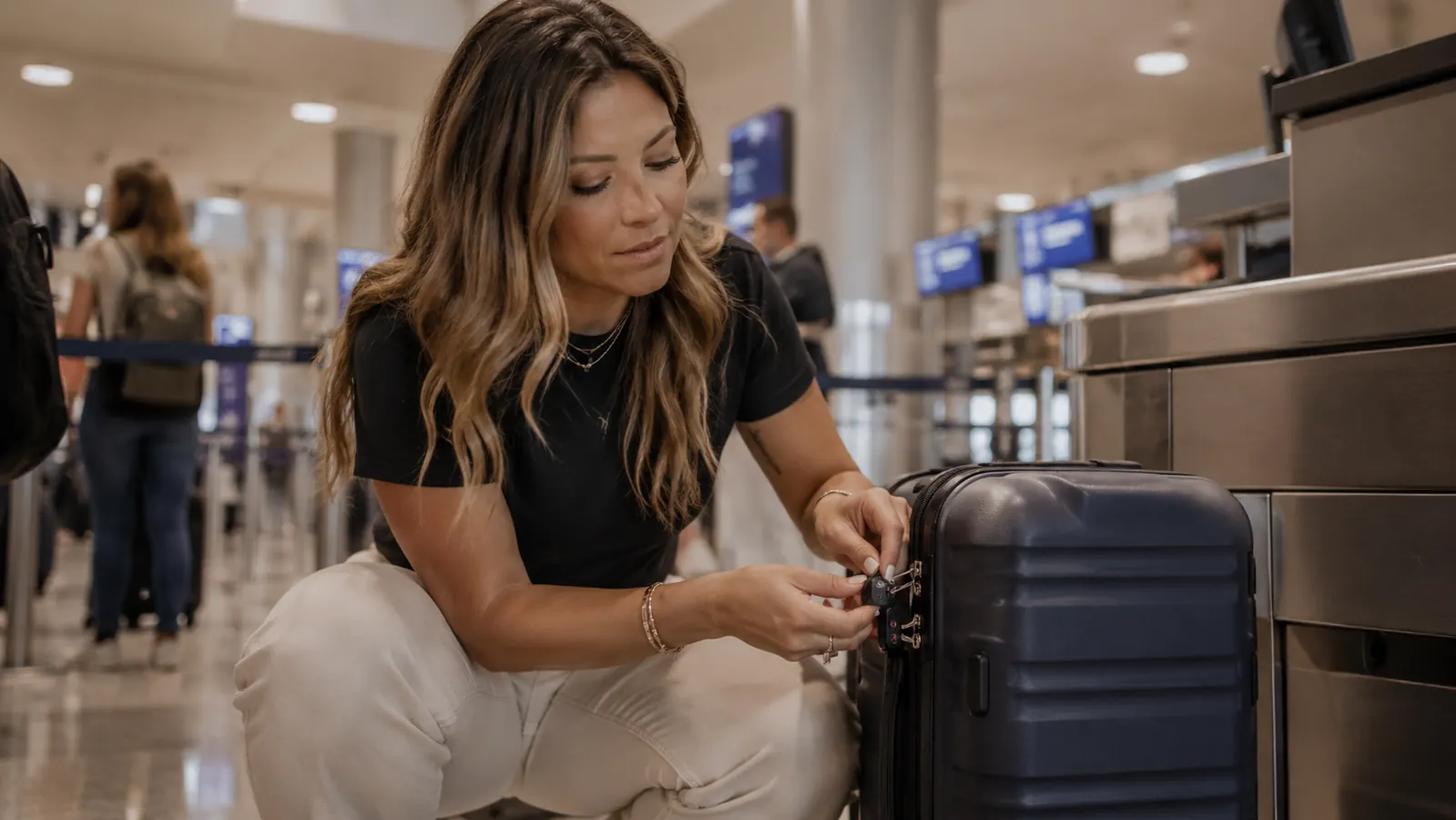
I have checked hundreds of bags over the years and I have had exactly two go sideways: one that came back with a broken zipper pull and one that turned up 24 hours late with a TSA inspection notice tucked inside. Both times, the problems I could prove were the ones I had documented before the bag left my hands. The problems I could not prove stayed unresolved. That experience turned me into someone who treats checked-bag security like a pre-flight checklist rather than an afterthought.
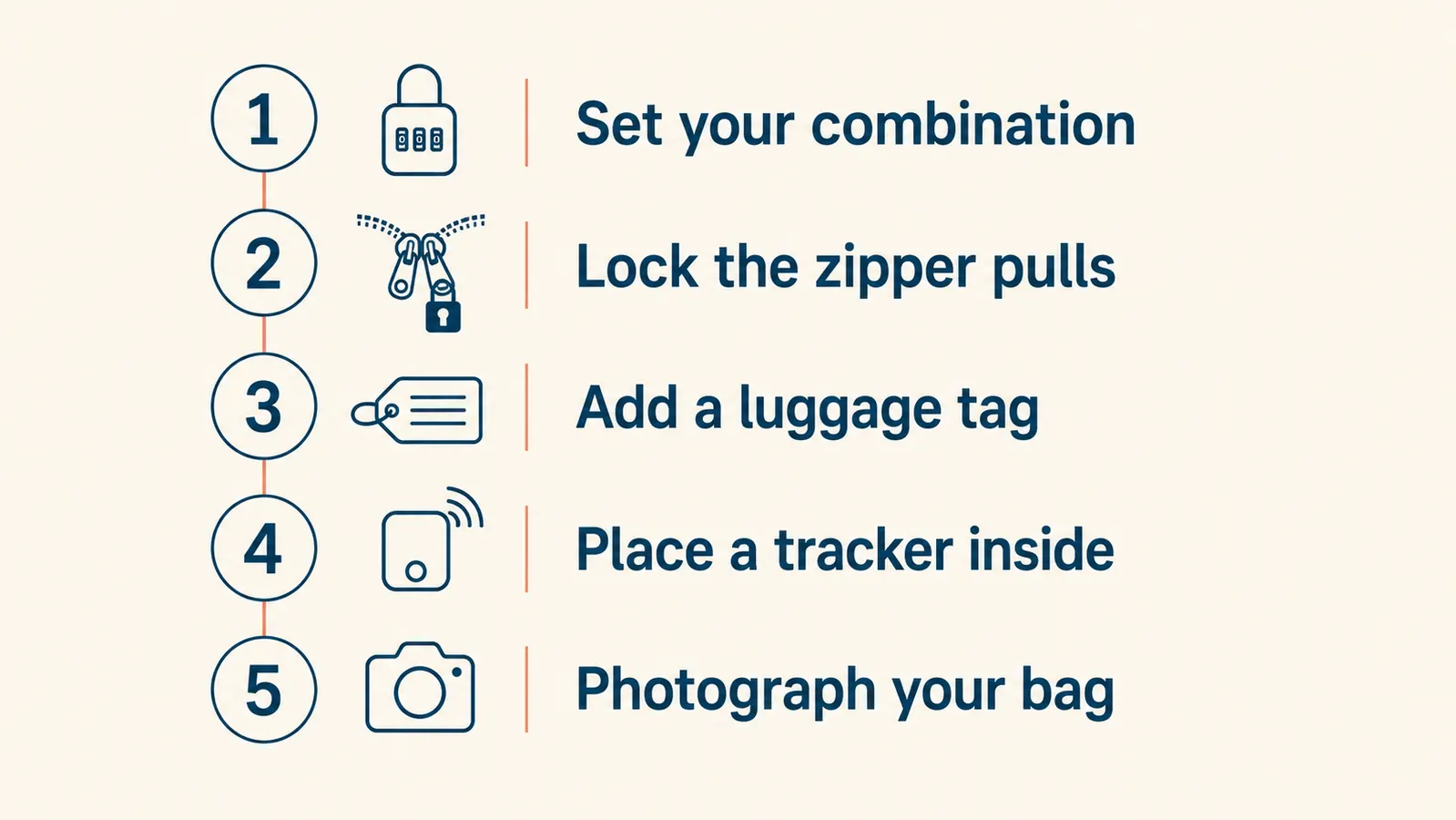
Most travelers lock their bag once and consider it done. But a real luggage security routine has five distinct steps, and most people skip at least two of them. This guide walks through each one, including the specific lock I use on every trip with checked bags: the Forge TSA Open Alert luggage lock, a zinc-alloy 3-digit combination lock that comes four to a pack and includes an open-alert indicator so you can tell at a glance whether TSA opened your bag while it was out of your sight.
If your bag has ever come back lighter than it left, this is the lock you want on every zipper.
The Forge TSA Open Alert lock comes in a 4-pack, uses easy-read dials, and is made from zinc alloy that holds up to repeated airport handling. It is the one I put on every bag I check.
Amazon Check Today's Price on Amazon →Step 1: Set Your Combination Before You Pack
This sounds obvious, but most people set the combination at the airport while the check-in line is moving. Do it at home, the night before you fly. Open the lock, find the reset mechanism (on the Forge lock it is a small button on the side you press with a pen tip while the shackle is open), set a 3-digit code you will remember, and test it three times before you close the lock. Write the code somewhere other than the luggage tag, because luggage tags fall off.
The Forge dials are large enough to read without squinting and rotate smoothly, which matters more than it sounds when you are standing in a busy baggage claim trying to get into your bag fast. I keep a note of the code in my phone's notes app under a label that does not say 'luggage combination' in case my phone is ever lost.
One more detail: change your combination after any trip where your bag was inspected by TSA. The TSA uses master keys to open TSA-approved locks without cutting them, so the combination itself is not what they use, but if anyone else ever saw you dial your code at baggage claim, a reset is a smart reset. Takes 30 seconds.
Step 2: Lock Every Accessible Zipper Pull, Not Just One
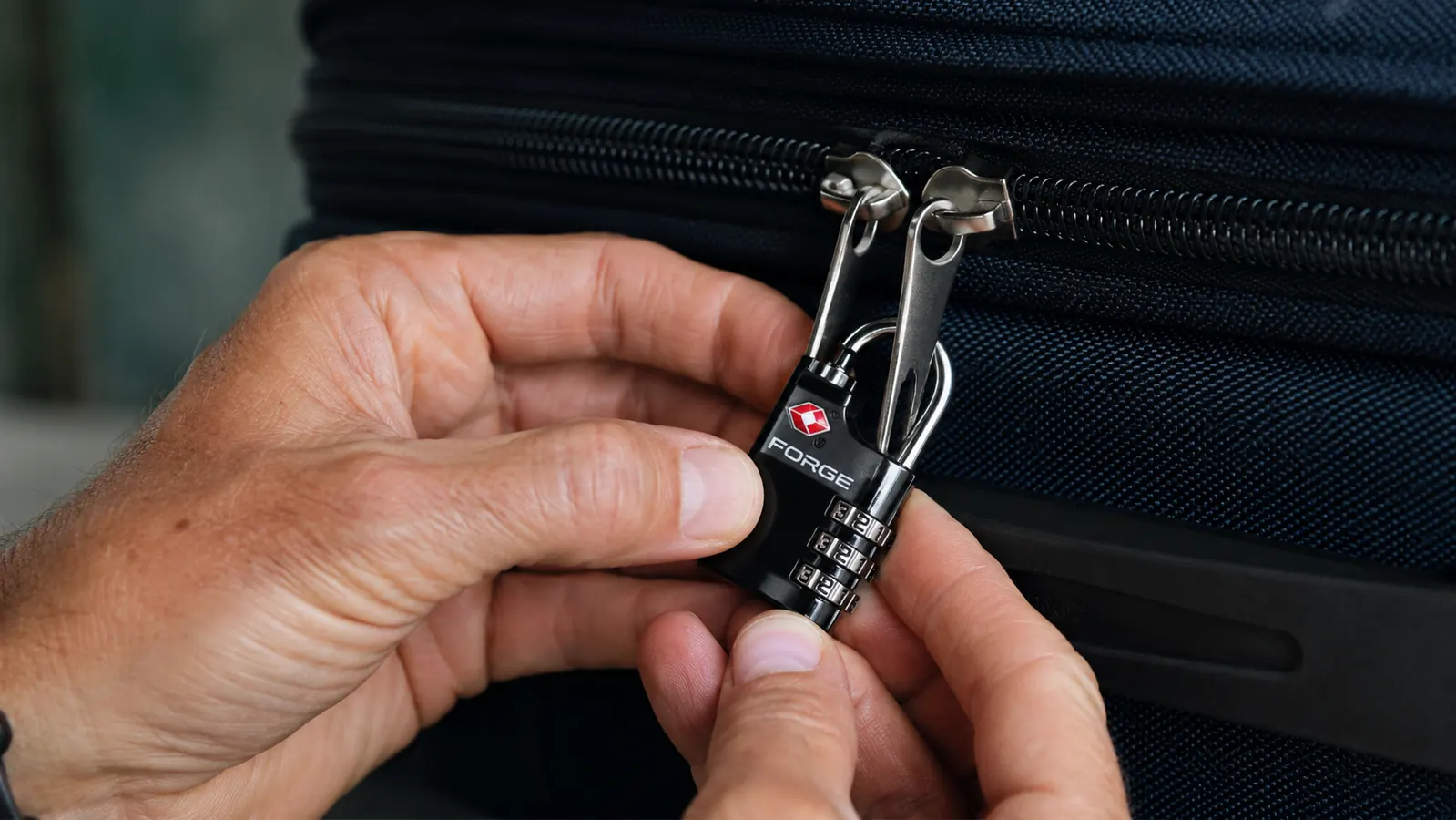
Most suitcases have two zipper pulls on the main compartment and one or two more on external pockets. A single lock on the main zipper pulls is standard practice. Locking the external pocket zippers is the step most people skip. That outer pocket is where people store their phone charger, a book, or their passport. It is also the easiest panel to access quickly in a busy baggage handling area.
The Forge 4-pack solves this directly. With four locks per box, you can put one on your main zipper pulls, one on any external pockets, and still have two left for a second bag or a future trip. I use one on each of my two checked bags whenever I fly with my family and we still have spares. A single lock on a 4-pack purchase is one of the more obvious value arguments in travel gear.
Thread the lock through both zipper pulls on the main compartment before you slide it shut, not after. Sliding a locked zipper pull is harder on the teeth than pulling it first and then locking. Your zippers will last longer.
Step 3: Add a Luggage Tag That Survives the Baggage System
The airline attaches a barcode tag to your bag. That tag handles routing. Your personal luggage tag handles the situation where the airline's tag falls off, which happens more often than airlines like to admit, especially on connecting flights where the bag is transferred multiple times. A missing airline tag means your bag sits in lost-and-found at a hub airport while the airline tries to match it to a passenger by description.
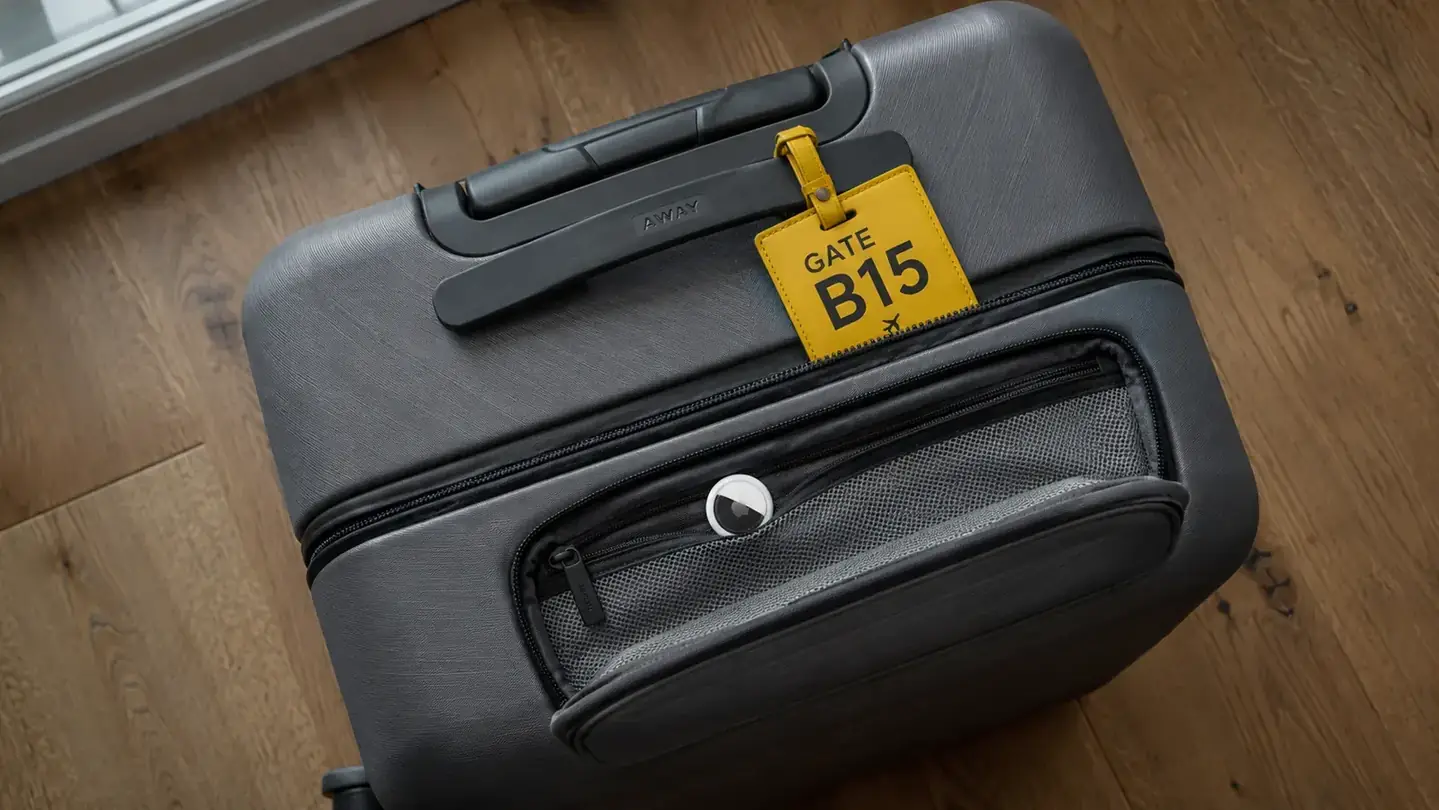
Your personal luggage tag should be hard plastic or aluminum, not paper, and should show your name, email address, and phone number. Skip putting your home address on an external luggage tag. Home addresses on luggage tags are a mild security risk: they broadcast that your house is empty while you are traveling. Email and phone are enough for the airline to reach you.
Attach the tag through the handle, pull the strap tight, and give it a firm tug. If the strap feels like it might slip through under pressure, replace it before you travel. Flimsy luggage tag straps are one of those things that look fine in a quiet kitchen and fail under the mechanical stress of a conveyor belt.
The problems I could prove were the ones I had documented before the bag left my hands. The problems I could not prove stayed unresolved.
Step 4: Place a GPS or Bluetooth Tracker Inside the Bag
An Apple AirTag or a Tile tracker slipped inside your checked bag gives you real-time or near-real-time visibility into where your bag is once it leaves your hands. This does not prevent theft or loss, but it dramatically shortens the resolution time when something goes wrong. Instead of filing a delayed bag report and waiting for the airline's system to catch up, you can open the Find My app and tell the baggage agent exactly which terminal in which airport your bag was last pinged.
I use an AirTag inside every bag I check. I wrap it in a small cloth pouch and tuck it under the packing cubes rather than leaving it loose. If your bag is delayed and you can tell the agent the last-known location from the AirTag, bags often get retrieved and expedited the same day rather than sitting in a general delayed-bag queue for 48 hours. That alone has been worth it twice over.
A few countries have restrictions on certain tracking devices in checked luggage, so if you are flying internationally, a quick search of your destination's regulations is worth doing before you pack the tracker. For domestic US travel, it is a non-issue.
Step 5: Photograph Your Bag and Its Contents Before Check-In
This is the step almost no one does, and it is the one that matters most if something goes wrong. Before you zip your bag for the last time at home, take a photo of the contents spread out on your bed. Then take a photo of the closed, locked bag at the check-in counter with the airline's barcode tag visible. Those two photos are your evidence if the bag is lost, damaged, or if something goes missing.
Airlines require you to file a Property Irregularity Report within 24 hours of arrival for domestic flights and within 7 days for international. The claim goes faster, and pays out more reliably, when you can say exactly what was inside and attach photos. Travel insurance claims work the same way. Most policies require a police report for theft and documentation of the items claimed. Photos taken before departure are the strongest documentation you can provide.
Also photograph the Forge open-alert indicator before you check the bag and again when you pick it up at baggage claim. The indicator is a small colored flag inside the lock body that flips when TSA opens the lock with their master key. If the indicator shows open, it does not mean something was stolen. TSA does routine inspections. But it tells you to do a quick inventory before you leave the airport rather than discovering a missing item three days later at your hotel.
What Else Helps
Beyond the five steps, a few habits make a real difference. Use a distinctive luggage identifier, a bright strap, a patterned luggage cover, or a piece of ribbon on the handle, so you can spot your bag quickly on the carousel and so it is less likely to be accidentally picked up by another passenger with a similar-looking black suitcase. Choose hard-shell luggage if you regularly check bags with fragile items. Hard-shell bags are harder to slice open with a blade, which is a real, if rare, method of opportunistic theft at some international airports.
If you are traveling to a destination with a higher reported incidence of luggage theft, consider wrapping your bag at an airport wrapping station. This adds a layer of transparent plastic film around the entire bag that makes tampering obvious without preventing TSA inspection. It is overkill for most domestic trips but a reasonable precaution for certain international routes.
Review what you are actually putting in checked bags. Electronics, medication, irreplaceable documents, car keys, and credit cards belong in your carry-on, not checked luggage. Airlines limit liability for these categories even when a loss is their fault. Your best security for high-value items is keeping them with you.
Four locks for two bags, two trips, or two travelers. Zinc alloy, easy-read dials, open-alert indicator.
The Forge TSA Open Alert 4-pack is the straightforward starting point for this whole routine. Set the combination tonight, and your bags are ready for every flight from here.
Amazon Check Today's Price on Amazon →