
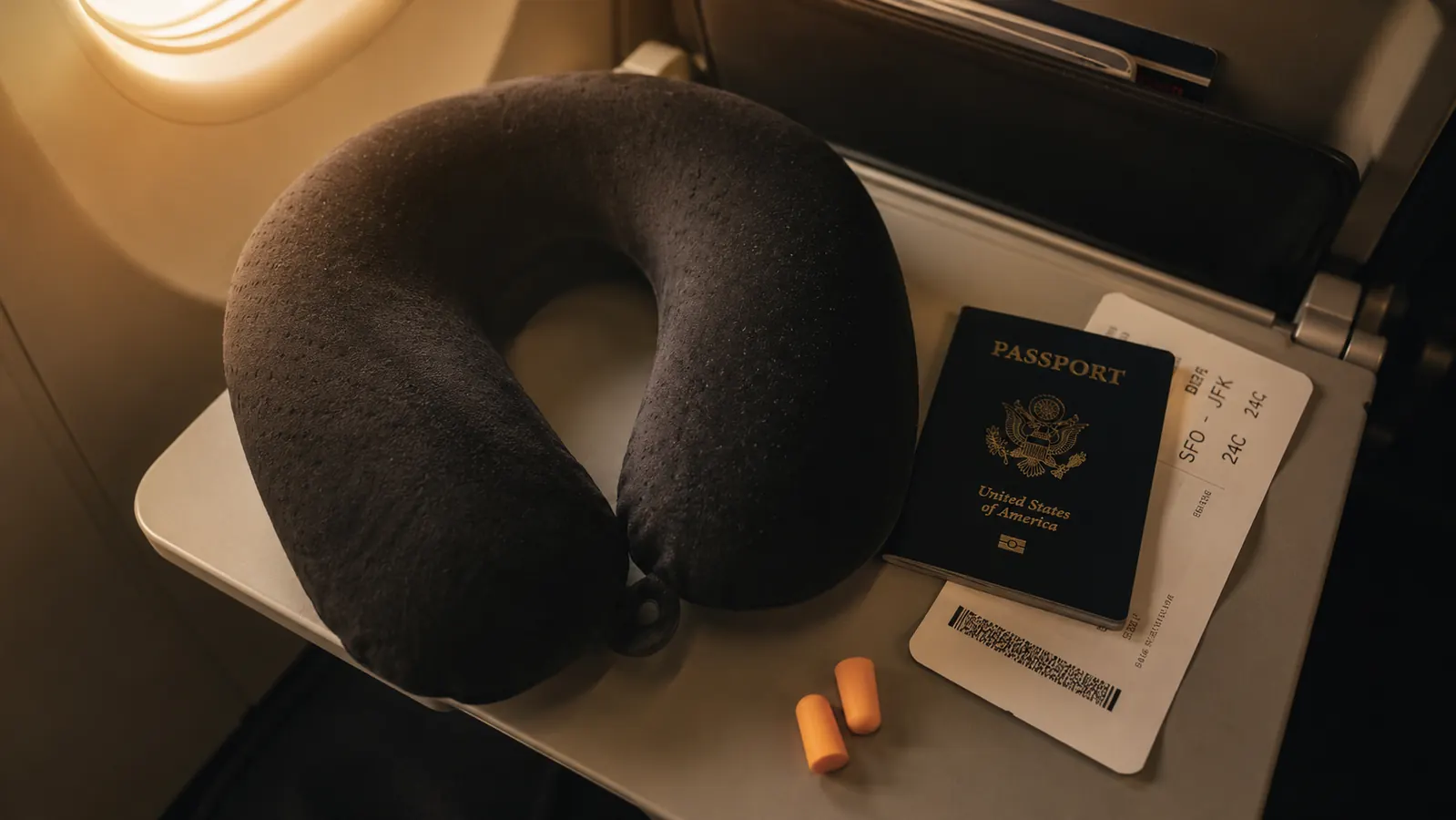
I nearly did not buy the MLVOC. Thirty-five thousand reviews and a 4.3-star average sounded like the kind of number a product accumulates after years of discount codes and review incentives, not because it was actually good. I bought it anyway after a miserable overnight from Denver to Amsterdam where the airline pillow I borrowed from my seatmate dissolved into a flat oval within two hours. I was desperate, the MLVOC was cheap, and the worst case was I was out the cost of an airport lunch. What I did not expect was for it to teach me something I had been doing wrong with neck pillows for years. The ratings gave me no hint of that.
This review is not a recount of every flight I have taken with the MLVOC, though I have taken quite a few. It is specifically about the things that 35,000 aggregate star ratings cannot tell you: the positioning detail that changes the entire experience, which seat types actually benefit from the hood and which ones make it useless, what the bundled accessories do as a coordinated system, and who should genuinely look elsewhere. If you want the flight-by-flight long-term breakdown, that lives in my six-month review of the MLVOC. This is the stuff that review left out.
The Quick Verdict
The MLVOC earns its rating for one specific reason most reviews miss: a single positioning adjustment turns a decent pillow into an exceptional one. The hood is useful for window-seat travelers and frustrating for everyone else. The kit genuinely works as a system.
Amazon Check Today's Price →Tired of landing with a stiff neck and a headache? There is a specific reason this pillow fixes that.
The MLVOC bundles 100% memory foam support with a 3D eye mask, earplugs, and a carry bag. Check today's price on Amazon and see if it is still under the cost of a single checked bag fee.
Amazon Check Today's Price on Amazon →The One Thing 35,000 Reviews Almost Never Mention
Every neck pillow review says something like "comfortable support" or "held my head in place." None of them tell you that the MLVOC has a specific front-to-back orientation that most people get wrong on first use, and getting it wrong makes the pillow feel mediocre. The MLVOC is asymmetric: one arm of the U-shape is taller and denser than the other. The taller side is meant to sit at the rear of your neck, not under your chin. Almost every first-time user puts it on the standard way, with the gap at the front, and ends up with the smaller arm at the back offering much less support.
When you flip it so the opening faces forward and the tall arm cradles the back of your neck, the foam pushes your head slightly upright and forward, which is exactly the position a physical therapist would put you in to avoid strain. The difference is immediate and noticeable on a flight longer than three hours. My first use with the correct orientation was a Denver to Reykjavik leg, seven hours on an Icelandair 767, and I arrived with no neck tension for the first time on that route. I had used the pillow once before in the default orientation and thought it was fine but not remarkable. The orientation was the entire variable. MLVOC includes a small instruction card that mentions this, but it is easy to miss in the packaging and no Amazon photo shows it clearly.
The Hood: Honest Assessment by Seat Type
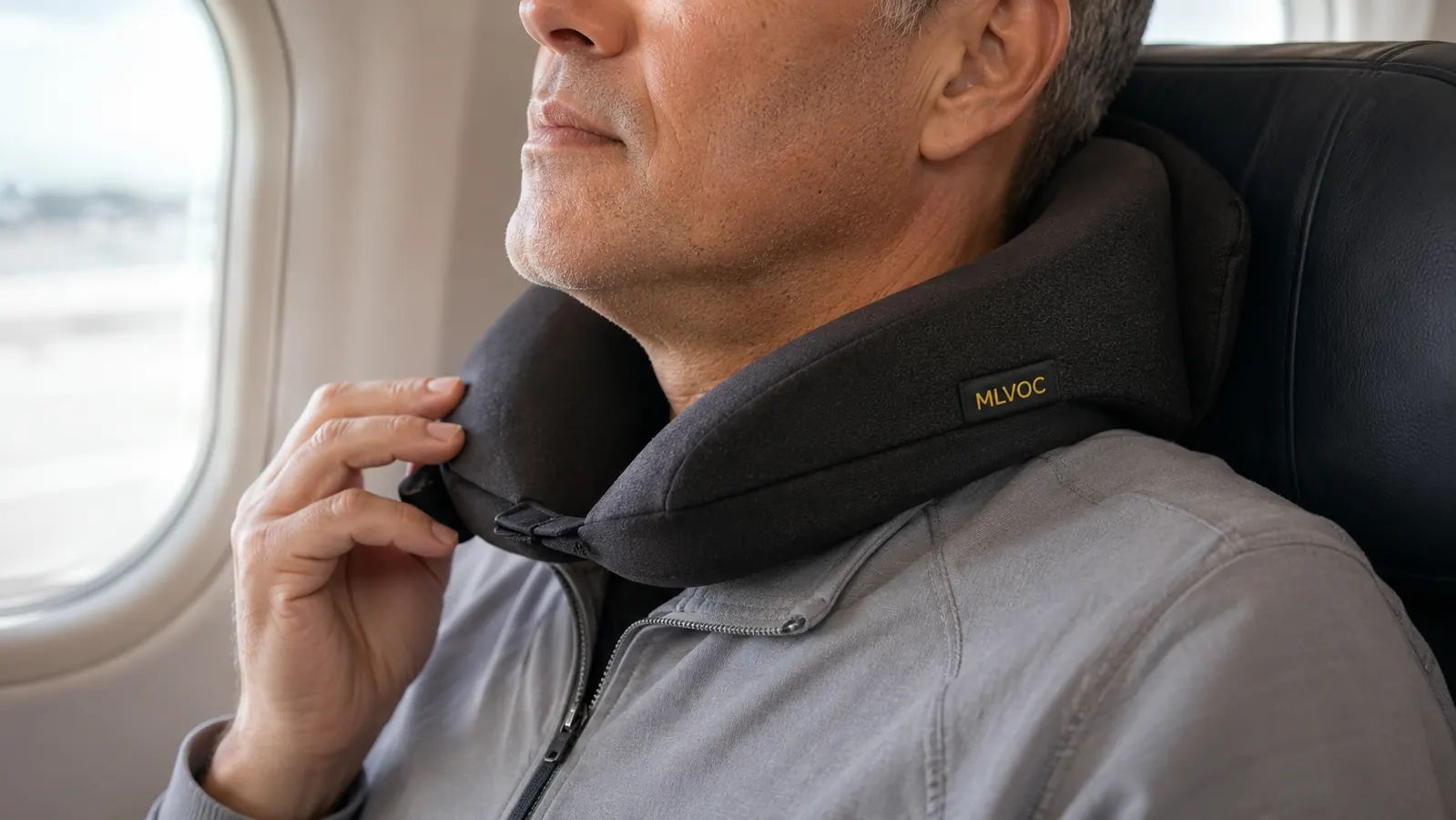
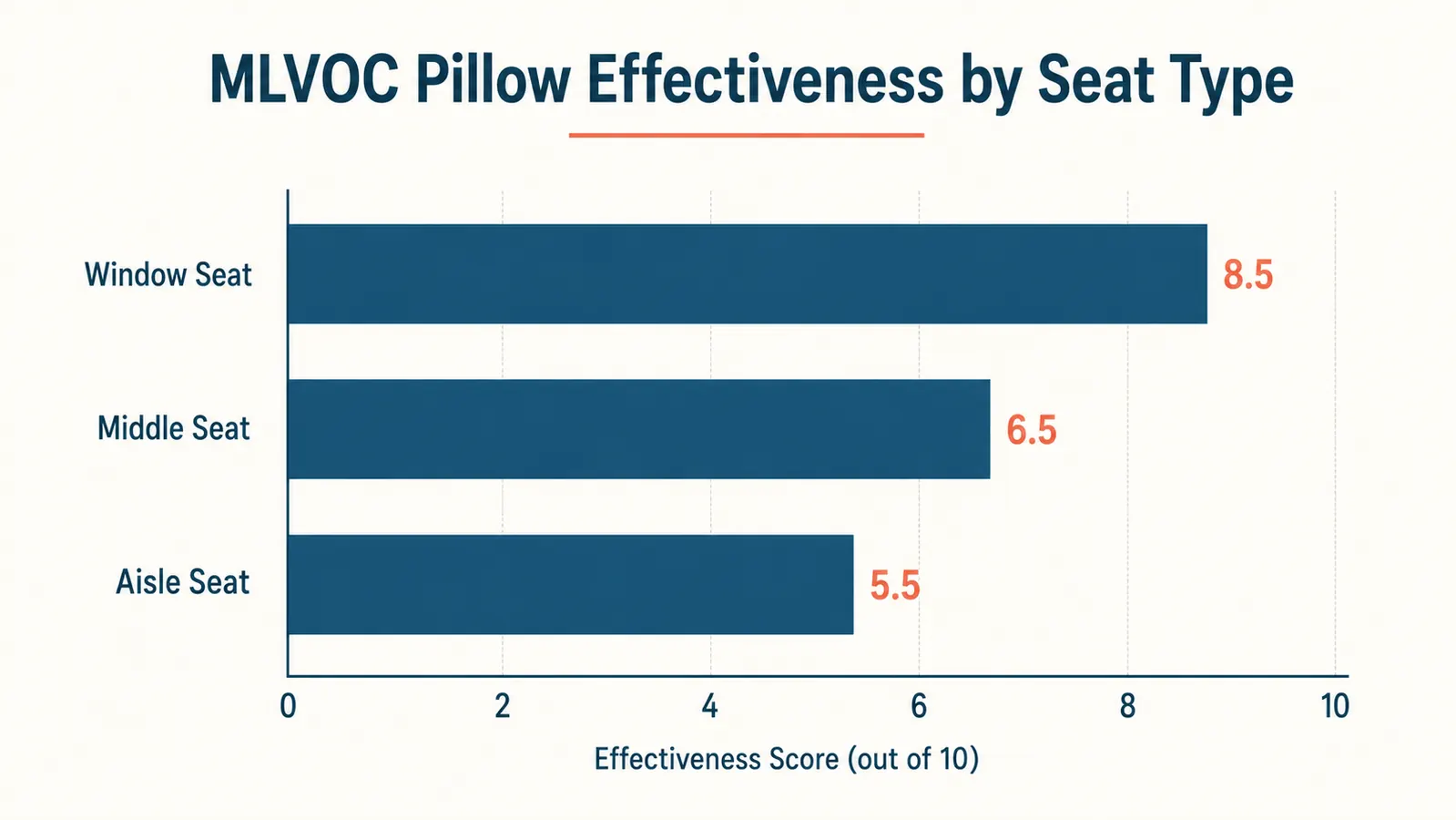
The snap-on hood is the MLVOC feature that generates the most mixed reviews, and the reason the reviews are mixed is that its effectiveness depends almost entirely on which seat you are in. Let me be specific about this because the aggregate rating cannot be.
Window seat travelers on the correct side of the aircraft get real value from the hood. The hood attaches to the left arm of the pillow and sweeps forward and over to block light from the right side. If you are in a left-facing window seat, the hood blocks overhead cabin light and the ambient glow from your neighbor's screen. That is genuinely useful for overnight flights in economy where personal light control is limited. On a recent SEA-LHR overnight I used the hood in a window seat and it meaningfully reduced the light hitting my face from the aisle side, which made the 3D eye mask I was already wearing even more effective.
Middle and aisle seat travelers get much less from it. In the middle, you have light sources on both sides and the hood only addresses one. In the aisle, the main light nuisance is from the galley and overhead bins, not from the side the hood covers. I tested this on a transatlantic middle seat and the hood was mostly decorative. If you almost always book window seats, the hood is a minor bonus. If you book middle or aisle seats because you need to get up, skip evaluating the hood as a feature at all and focus on whether the foam and fit work for you.
The hood is a window-seat feature in a middle-seat world. Know which one you are before you factor it into the buying decision.
What '100% Pure Memory Foam' Actually Means Here
Memory foam is not a single specification. It is a category, and within that category there is a wide range of density, responsiveness, and heat retention. MLVOC markets the pillow as 100% pure memory foam, which distinguishes it from hybrid pillows that blend memory foam with shredded fill or gel beads. In practice, what this means for a traveler is that the foam has a single consistent feel throughout and will not develop soft spots or lopsided compression the way shredded fill pillows do over time.
The density on the MLVOC sits at the firmer end of the memory foam range. This matters for two different traveler types in opposite ways. If you tend to sleep sitting slightly upright with your head resting against the seat back, the firmness is excellent: your head stays where you put it and the foam does not compress away from your neck after an hour of sleep weight. If you sleep with your head tilted to the side, leaning into the pillow itself, the firmness can feel a little unyielding in that lateral position. The pillow is built for upright sleep, not side-leaning sleep. Tall travelers with longer necks sometimes find the loft a touch low for that upright position, which is the one sizing complaint that shows up consistently in the one and two-star reviews and is worth taking seriously if your neck is above average in length.
On heat: memory foam traps warmth, and the MLVOC does run slightly warm on long flights, particularly in the second half of an overnight when cabin temperatures tend to rise. The velour cover does not have a cooling layer. If you run hot on planes, this is worth knowing. It was not a dealbreaker for me but it is a real characteristic, not a rumor.
The Accessories as a System, Not Three Random Items
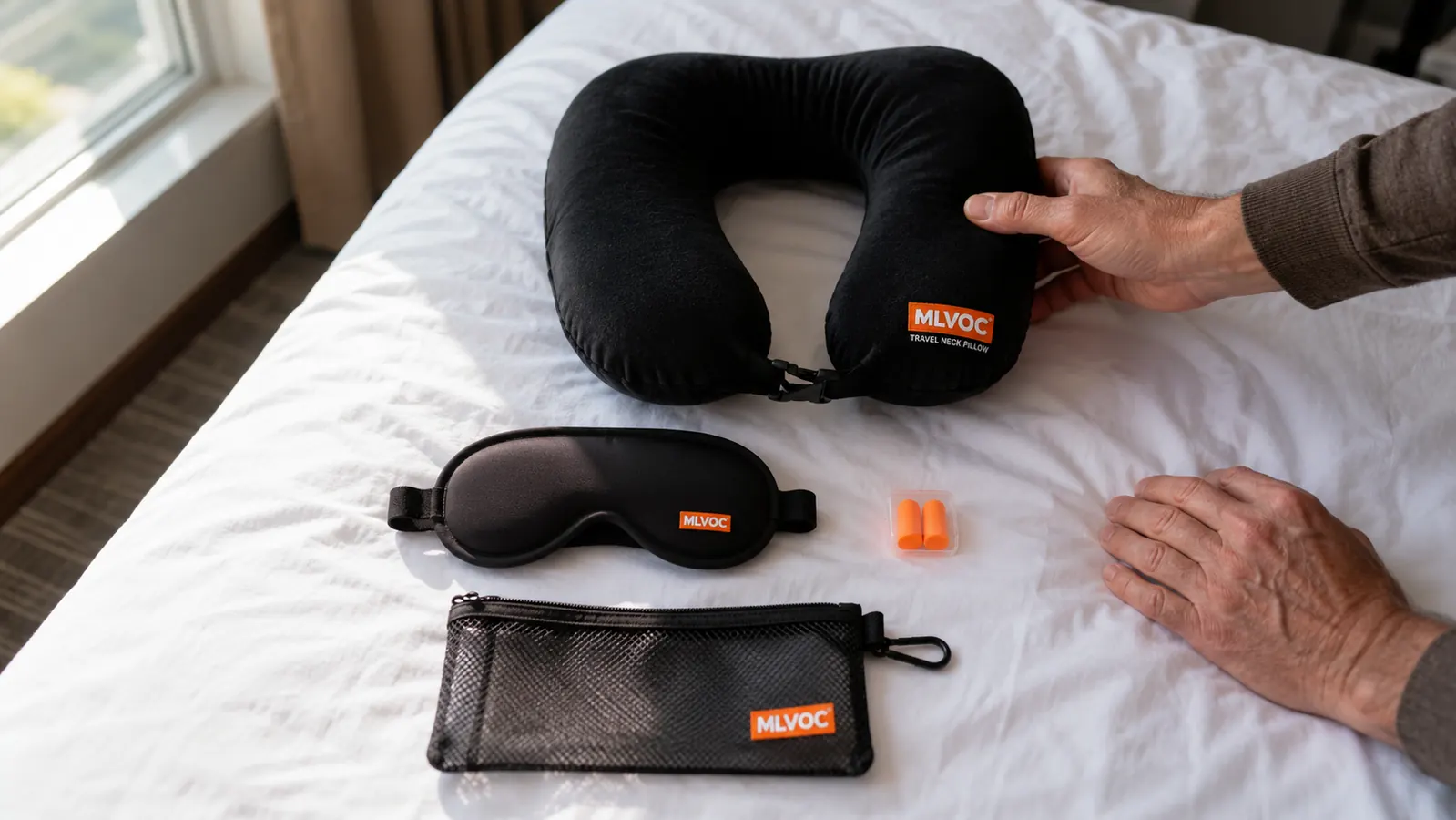
Most reviews mention the eye mask and earplugs in passing, give them a sentence, and move on. That understates what they do when you use them together on purpose. Here is how I pack and use the MLVOC kit as a coordinated sleep system rather than a pillow with two bonus items.
The 3D eye mask is designed with a contoured interior shell that lifts the fabric off your eyelids. That design detail matters more than the material. Most flat sleep masks press against your eyelids and create a low-grade pressure that is uncomfortable for REM sleep. The contoured shell on the MLVOC mask eliminates that. I use it with the pillow in correct-orientation rear-neck mode, which positions my head upright enough that the mask sits flat against my face without being pushed by the headrest. The earplugs lower ambient engine noise to a level where the slight white noise of the air system is actually sleep-inductive rather than disruptive. None of these items is extraordinary on its own. Together, in a window seat, with the pillow in the right orientation and the hood deployed, they create a genuinely effective sleep environment for a price that is hard to justify arguing against.
The carry bag is the weakest piece. It is nylon mesh, adequate for holding the compressed pillow, but the zipper stiffens with use and the mesh offers no protection against anything being pressed into the bag in an overhead bin. I now keep the pillow inside the carry bag and then inside a packing cube sleeve rather than loose in the overhead, which adds ten seconds of retrieval time but protects the cover from getting caught on luggage hardware. The bag's main value is that it keeps the kit together and keeps the eye mask from getting creased in transit.
Short Flight vs Long Flight: Two Different Verdicts
The aggregate rating blends every type of traveler, which is why the MLVOC scores a 4.3 rather than a 4.7 or a 3.9. The reality is that the MLVOC delivers a meaningfully different experience depending on flight duration, and the rating cannot separate that.
On flights under three hours, the MLVOC is good but not essential. The foam takes about ten minutes to fully conform to your neck shape, which means a two-hour flight is nearly over by the time it settles in. The bulk of carrying a memory foam pillow through security and storing it overhead is harder to justify when you could skip sleep entirely and just watch something for two hours. The inflatable alternatives make a stronger case for themselves on short-haul travel purely on pack size.
On flights over six hours, the calculus inverts completely. Inflatables lose air pressure over time, which means the support you had at hour two is noticeably softer at hour six. Memory foam does not compress with time. The MLVOC at hour eight on an overnight feels identical to the MLVOC at hour one, which is not true of any inflatable I have tried at any price. For long-haul travelers, the MLVOC is the correct category of pillow. For short-haul travelers who want something ultralight, compare it against inflatables before buying. For a full comparison with the Cabeau Evolution, the other major memory foam competitor at this price, see the head-to-head review.
What We Liked
- Reversed orientation discovery changes the experience from decent to genuinely supportive
- Memory foam holds its support consistently through multi-hour overnight flights without compressing
- 3D eye mask contour keeps fabric off eyelids, meaningfully better than flat sleep masks
- Works as a coordinated three-item sleep kit when used together, not just a pillow with filler accessories
- Price relative to individual purchase of comparable eye mask and earplugs makes the kit strong value
Where It Falls Short
- Hood effectiveness is heavily seat-type dependent and adds little for middle or aisle travelers
- Firmer foam density is ideal for upright sleepers, less so for side-leaners or travelers with longer necks
- Runs slightly warm on long overnight flights, no cooling layer in the cover
- Carry bag zipper stiffens with repeated use over several months
- Orientation instructions are easy to miss, meaning many buyers never use the pillow correctly
The Questions Buyers Ask That Reviews Do Not Answer
Three questions show up in the Amazon Q and A section repeatedly and the answers buried there are worth surfacing here. First: can you wash the full pillow or just the cover? Just the cover. The memory foam inner is enclosed in a separate sewn liner that you do not remove. The outer velour cover zips off and goes in the machine on a gentle cold cycle. Air dry only if you want the velour to stay soft. Second: does it compress small enough to fit in a personal item bag? With moderate hand compression it fits in a standard backpack side pocket, roughly the footprint of a 20-ounce water bottle. It is not as small as an inflatable but it is much smaller than it looks in product photos. Third: are the earplugs reusable? Yes, they are standard foam roll-down plugs rated at NRR-29 and they are washable. They are not specialty sleep earplugs but they are the correct grade for cabin noise reduction and they hold their shape across many uses.

Who This Is For
The MLVOC is for travelers who take at least one flight per year over five hours and want a sleep kit they do not have to assemble piece by piece. It is specifically right for window-seat sleepers who book overnight long-haul routes and want light control built into the pillow rather than separately sourced. It is also right for travelers who have tried cheap inflatables and been disappointed by the slow deflation problem. If you are starting from scratch and you want one purchase that covers neck support, eye blocking, and ear protection without researching three separate products, the MLVOC is the most efficient way to get there at this price. For a broader look at why memory foam earns the upgrade over inflatable alternatives across different traveler types, the full reasons rundown covers that ground in detail.
Who Should Skip It
Skip the MLVOC if you primarily fly short domestic routes under three hours, because the bulk-to-benefit ratio is harder to justify and an inflatable will serve you better. Skip it if you have a long neck and need adjustable loft, because the MLVOC has a fixed foam height and cannot be tuned for different cervical proportions. Skip it if you run hot in transit and need an actively cooled sleep surface, because the velour cover traps heat and there is no gel insert option. And skip it if you nearly always book middle or aisle seats, want the hood as a key feature, and do not want to buy an eye mask separately, because the hood's coverage angle is built around window-seat geometry and it will not give you the light blocking you expect in the center of the cabin.
The rating is 4.3. The experience, with the right orientation and the right seat, is closer to a 9.
If long-haul flights are your problem, the MLVOC travel kit is one of the most complete fixes at this price point. Check today's price on Amazon, it moves up and down more than you'd expect.
Amazon Check Today's Price on Amazon →