
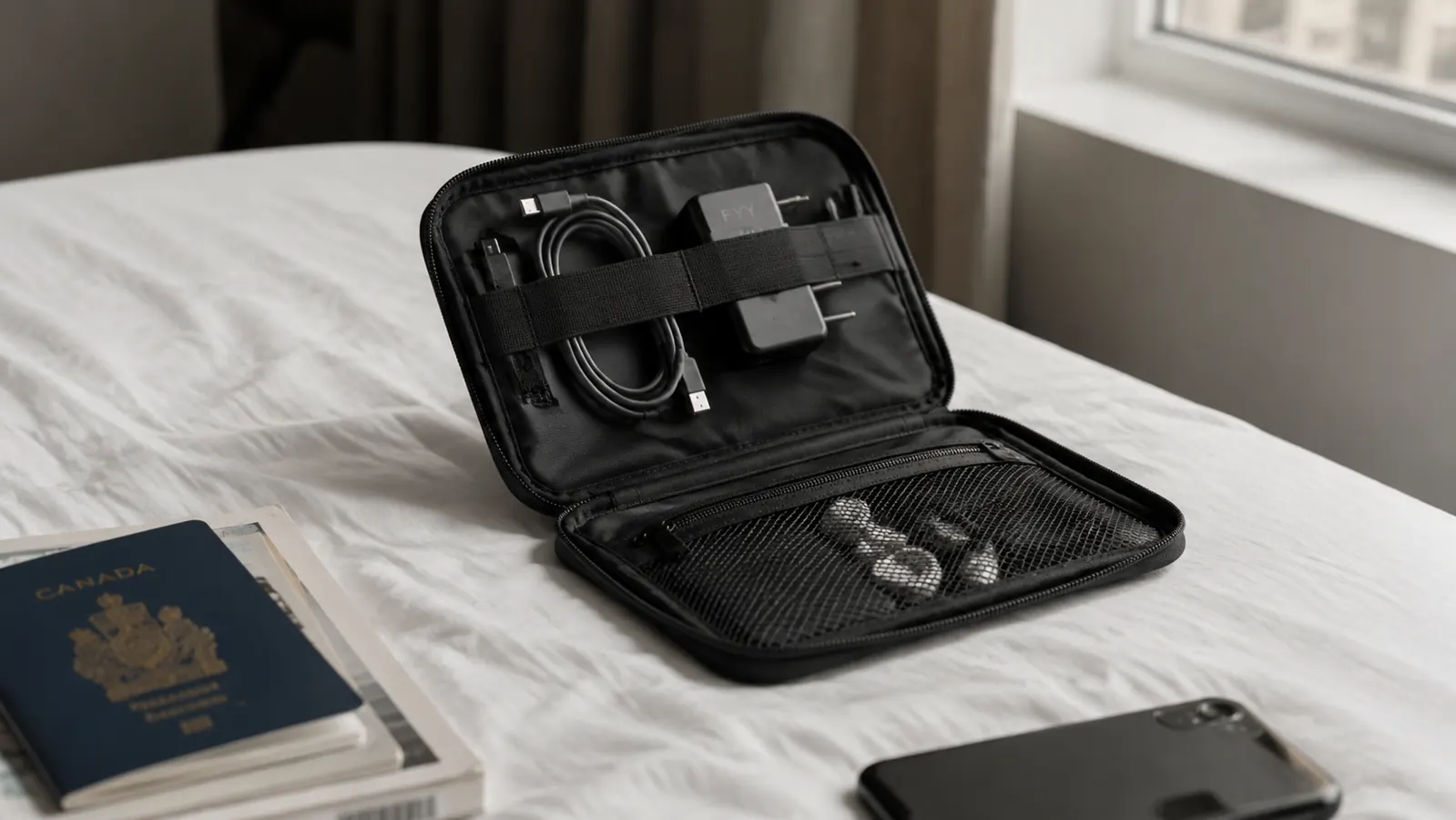
Here is what nobody writes in the headline: 38,000 Amazon reviews for a cable organizer is not luck. It is what happens when a product solves the exact problem it promises to solve, at a price that removes all hesitation from the purchase. The FYY Electronic Organizer has been near the top of its category for years, and most people who buy it end up keeping it. But there are a handful of things the listing glosses over that genuinely affect whether this is the right buy for your specific setup. That is what this review is about.
I want to get into the actual mechanics of how this organizer works, where it falls short for certain traveler types, and why the size decision matters more than FYY's product page makes it seem. If you are comparing this to a competing bag, or trying to figure out whether any cable organizer is worth the step up from a ziplock bag, this will help you decide faster.
The Quick Verdict
One of the most well-executed cable organizers at this price point, with a layout that genuinely separates gear and holds its shape over time, though the medium size catches many buyers off guard and the lack of hard-side protection rules it out for certain setups.
Amazon Check Today's Price →Your cables deserve a better system than the bottom of your bag.
The FYY double-layer organizer keeps every cable, adapter, and small accessory in its own slot so you stop hunting and start traveling. Over 38,000 verified buyers and counting.
Amazon Check Today's Price on Amazon →What the Star Rating Does Not Tell You
A 4.6-star average across 38,000 reviews sounds like a product with no real flaws. That is not quite the truth. The FYY's rating is high partly because it sets realistic expectations and delivers on them, and partly because most buyers are comparing it against the chaos of having no organizer at all. When you go from tangled cables stuffed in a side pocket to a clean double-layer layout, almost anything feels like a win. That context matters when interpreting the score.
What the aggregate rating obscures: a meaningful percentage of one and two-star reviews are about the size mismatch between what buyers expected and what arrived. The medium is smaller than most people picture from the product photos. If you have a wall adapter that is larger than a standard 20W block, a power bank above 10,000 mAh, or a USB-C hub with a long body, things get tight quickly. Buyers who expected to fit their entire tech kit plus a spare hard drive are the ones leaving three stars.
The other thing the rating hides: this is a soft-shell organizer. There are no rigid panels, no foam inserts, no padded dividers. For cables, adapters, and earbuds, that is completely fine. For anyone carrying fragile gear, the rating does not reflect that experience at all because buyers with fragile gear tend to buy a different product category in the first place.
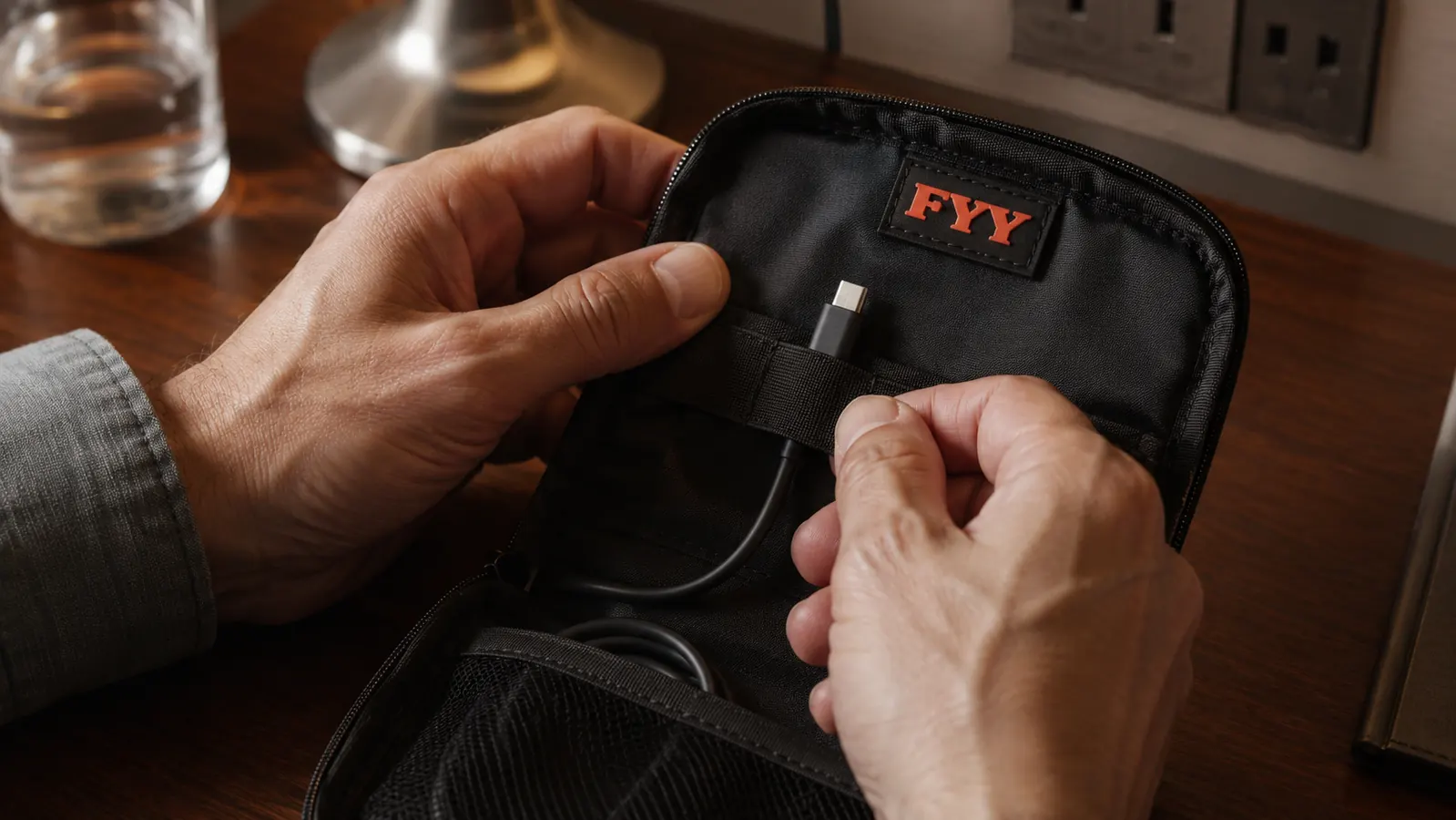
The Size Question, Answered Honestly
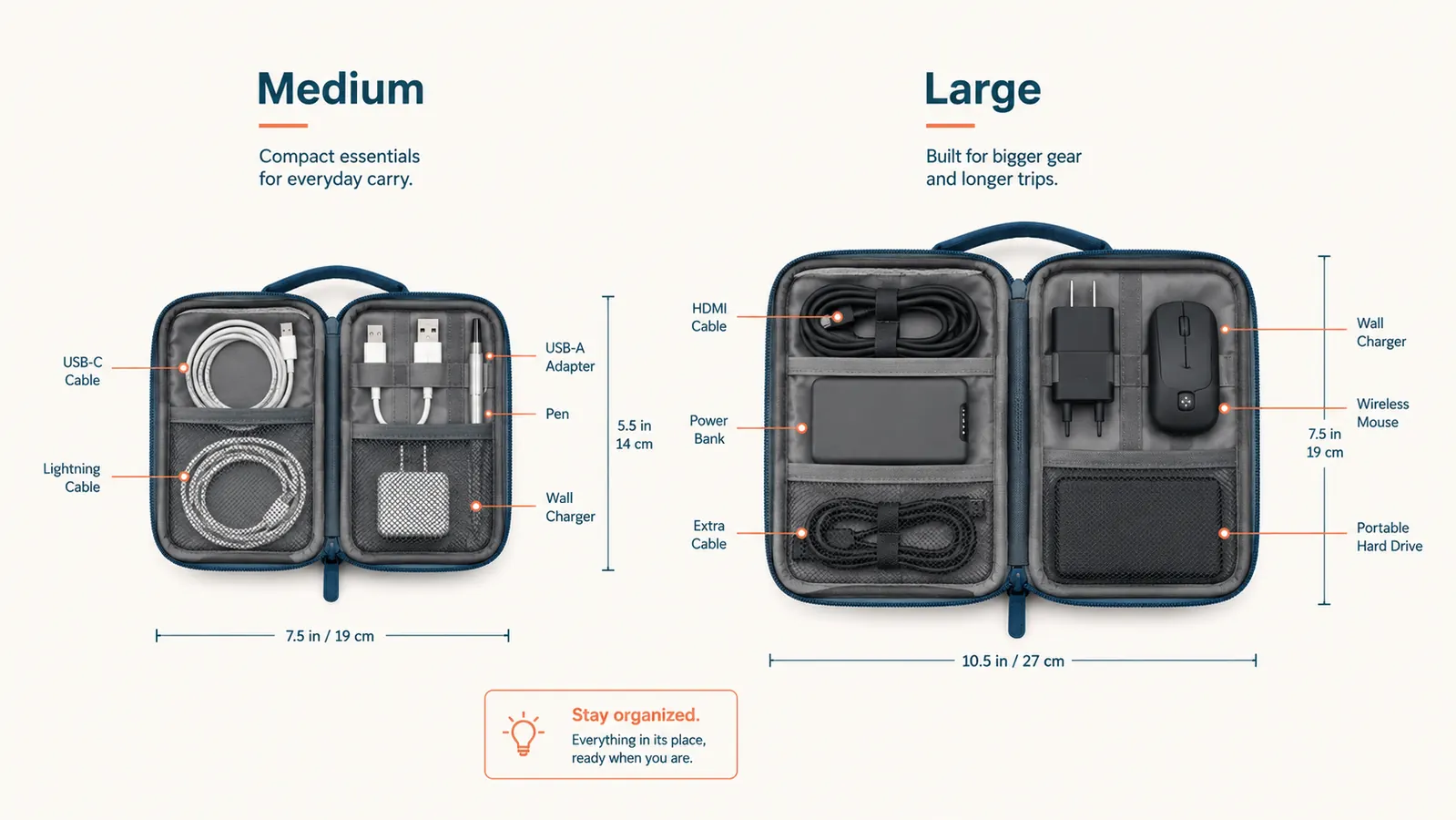
FYY sells this organizer in medium and large. The medium measures approximately 9 inches by 6 inches closed. The large is closer to 11 by 7. The difference sounds modest but it changes what you can realistically fit, and the medium is far more commonly purchased because it photographs well and has a lower price anchor.
Here is the gear test that most people should run before buying: lay out everything you normally carry for travel. USB-C cable, wall adapter, phone cable, earbuds or wireless earbuds case, power bank. If that is your full list, medium fits it with room to spare. If you add a universal travel adapter, a second charging cable, a small USB-C hub, and a micro-SD card reader, you are pushing the medium close to its limit. Adding a portable hotspot device or a second power bank tips you into large territory.
Business travelers and digital nomads who carry more gear than the average vacationer tend to be happier with the large. Occasional travelers doing short trips with a minimal kit often find the medium more than adequate and appreciate that it disappears into a smaller bag pocket. The mistake is buying medium because it is cheaper without actually measuring your gear first.
How the Double-Layer System Actually Works in Practice
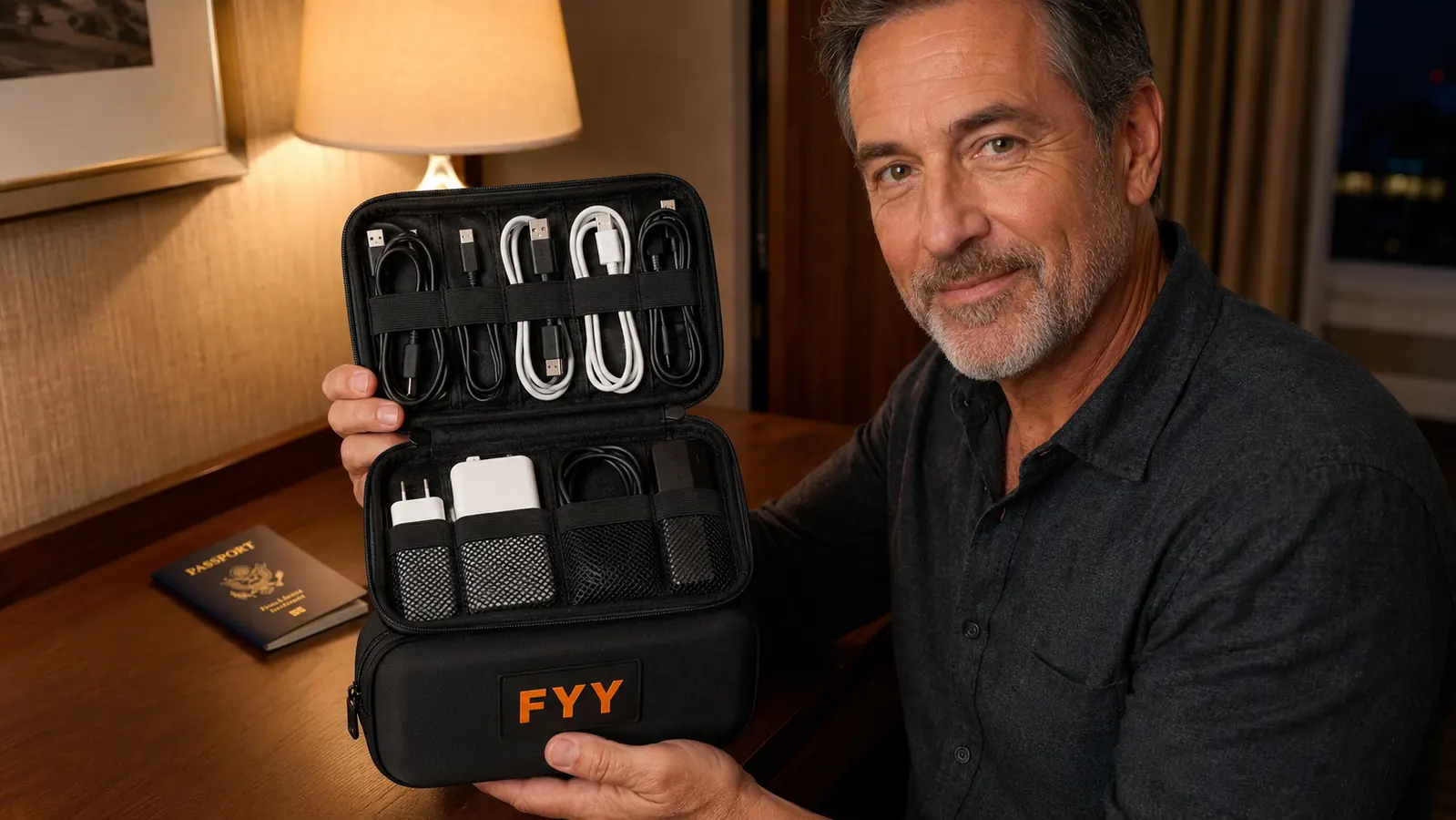
The design opens like a book. When you unzip it fully and lay it flat, you get two distinct surfaces facing you. The top layer (the side with the clamshell lid) has a row of elastic loops in three sizes and a small zippered mesh pocket in the corner. The bottom layer has a larger open mesh pocket and a second small zippered compartment. The idea is that you separate your most-used items (top layer, quick access) from less-often-needed ones (bottom layer, protected but slower to reach).
In practice the system works, with one behavioral shift required: you have to commit to putting things back in their designated spots every time. The FYY does not organize itself. If you use a cable and shove it back into the open mesh pocket instead of threading it back through its loop, the advantage disappears within one trip. That sounds obvious, but it is the single reason some people abandon cable organizers after a few weeks. The habit of re-looping is a thirty-second investment that makes the next departure completely frictionless.
The elastic loops deserve more credit than they typically get in reviews. They are sized to actually hold cables without letting them slide free, and they have stayed at consistent tension over repeated use. Cheaper organizers use thin elastic that starts to go slack within a few months, which renders the loops useless. The stitching on these loops is visibly heavier than on budget alternatives, and that construction choice is what makes the system reliable long-term.
The FYY does not organize itself. Commit to re-threading your cables after every use and it pays that habit back every single time you reach for your bag at a gate, a hotel room, or a coffee shop.
Waterproof Claims: What They Mean and What They Don't
FYY describes the lining as waterproof, and the interior does have a coated nylon surface that resists liquid. This holds up in the most common travel scenario: something wet getting near your bag, a leaky water bottle in the same compartment, a sudden rain catching your open backpack. The interior wipes dry and does not hold moisture the way uncoated fabric would.
What the waterproof claim does not mean: this is not a submersible case. If your bag goes into standing water, or you drop it in a puddle and it sits there, water will find its way through the zipper seam. The zippers are not waterproof-sealed. For normal travel use, the water resistance is genuinely useful. For kayaking, beach trips where electronics get wet, or situations where full submersion is a real risk, you need a hard-shell waterproof case, not this.
The exterior nylon is also water-resistant in a light-rain sense. It will bead off a brief drizzle. It will not hold up to being left out in heavy rain. Again, for airports, hotel lobbies, and normal travel, that level of protection is exactly right. Managing expectations here matters because some reviewers seem to have expected a sealed dry bag.
Who Buys This Wrong
Photographers who travel with a mirrorless camera body, extra lenses, or flash equipment sometimes gravitate toward the FYY because the price and the category description make it sound like the right solution. It is not. The FYY has no padding, no dividers, and nothing that would absorb an impact or prevent lens elements or glass filters from cracking if the bag gets compressed in a tight overhead bin. Camera gear needs a dedicated case with foam or padded inserts. The FYY is for cables, cords, adapters, and small accessories that are durable under compression.
People who travel ultralight and pride themselves on a one-bag setup sometimes feel like the FYY is redundant because they already keep their cables minimal. If you are down to a single USB-C cable, a 20W adapter, and wireless earbuds, a small zippered pouch costing a few dollars does the same job for less. The FYY earns its price when your cable count is high enough that a flat organizational system saves real time. Below roughly four or five items, the benefit is marginal.
Family travelers who pack for multiple people and try to put everyone's charging cables into one shared organizer are setting themselves up for frustration. The medium is sized for one person's tech kit. One adult traveling with kids who each have a tablet and a gaming device is better served by a larger bag category or individual small pouches per person. Sharing one FYY among three people's gear does not scale.
What We Liked
- Double-layer layout creates a logical two-zone system that actually stays organized across trips
- Elastic loops maintain grip and shape over extended use, not just the first few weeks
- Interior waterproof coating handles incidental spills and light moisture without issue
- Compact closed dimensions fit into most carry-on front pockets and personal item pouches
- Strong zipper pulls with good material construction at the seams
- Medium size is genuinely right-sized for most solo travelers' cable and adapter load
Where It Falls Short
- Medium size is smaller than many buyers expect, worth checking your gear list before choosing
- No hard-shell protection, not suitable for fragile electronics like small drives or glass items
- Zipper seams are not waterproof-sealed, not a substitute for a fully sealed dry bag
- Color selection is limited and the available options (black, gray, rose gold) can be hard to spot in a dark bag interior
- No pass-through or external pocket for grabbing a single item without opening the whole organizer
How It Compares to Just Using a Ziplock Bag
This comparison sounds dismissive but it is one worth taking seriously because a lot of travelers genuinely do use a ziplock bag for cables and find it works fine. Here is what the FYY adds that a ziplock does not: the elastic loops keep cables separated, which eliminates the tangling problem entirely. A ziplock keeps cables contained but they are still loose inside, still tangling together, still requiring untangling at the gate. The FYY's loop system prevents that from happening in the first place.
The waterproof interior is also meaningfully better than a ziplock for everyday use because the bag structure holds its shape when partially packed. A ziplock collapses and flops. The FYY sits flat, stays open when you want it open, and closes neatly when zipped. For a traveler who opens and closes their cable bag multiple times per day across a long trip, that structural difference accumulates into a noticeably smoother experience.
That said, if you are doing a single overnight trip with three items, the ziplock is fine. The FYY justifies itself most clearly over multi-day or multi-stop trips where you are accessing your cables frequently and the friction of tangling and hunting adds up. At its current price, the break-even on convenience is very low.
Who This Is For
The FYY Electronics Organizer makes the most sense for a traveler who carries a laptop charger, a phone charger, earbuds, and at least one or two other small accessories, and who takes more than a couple of trips a year. That describes a huge portion of the travel market, which is partly why this product has the review count it does. Business travelers who live out of carry-ons will get the most obvious benefit because the time savings at hotel rooms and airport gates compound quickly across frequent trips. But even a vacation traveler doing four or five trips a year finds that having a dedicated, organized cable bag removes one small but persistent source of travel stress.
It also works well as a daily carry for people who take their tech gear back and forth between home and an office or coworking space. The double-layer layout makes it easy to grab everything in one motion rather than hunting through a bag for individual items. The medium size fits into a work tote or a laptop bag side pocket without bulk.
Who Should Skip It
Skip the FYY if you need hard-shell protection for fragile gear, if your cable list is so minimal that a pouch is overkill, or if you regularly pack for multiple people and are hoping one bag covers everyone. Also skip it if your primary concern is having cables accessible without opening a bag at all, since the FYY requires you to unzip and open flat to use it. There are slimmer, portfolio-style organizers with individual outer pockets that suit that use case better, though they typically cost more and offer less overall capacity.
If bright colors matter to you for finding your bag quickly inside a dark backpack, the limited color palette is worth noting. Black and dark gray disappear in most bag interiors. If visibility inside a packed bag is important to your system, look at organizers that come in yellow, orange, or other high-contrast colors. FYY does not offer those options currently.
If your cable situation is a mess every time you leave for a trip, this solves it.
The FYY organizer keeps everything in a designated spot, holds its shape trip after trip, and comes in at a price that makes it a low-stakes decision. Check current pricing and availability on Amazon.
Amazon Check Today's Price on Amazon →